On March 12, 2025, Evgeniya Blyznyuk, CEO & Founder of Gradus Research, will speak at the egta Market Intelligence Meeting 2025. She will present on “Understanding Audience Attitudes in Crisis,” sharing key insights into advertising perception based on 5,000+ interviews. Additionally, she will introduce Gradus AdSpot, a tool for rapid testing of advertising creatives.
To download the full presentation, please fill in the form below.
On February 28, 2025, a tense meeting was held between U.S. President Donald Trump and Ukrainian President Volodymyr Zelenskyy, during which Zelenskyy left the White House earlier than expected.
Gradus conducted a rapid poll the very next day, on March 1, to assess public support for the Ukrainian leader.
46% of respondents believe that Ukraine will be able to continue its fight against the aggressor even if U.S. assistance is reduced or cut off. However, a significant portion (36%) disagree. This suggests that a large segment of the population is prepared to continue resisting even in a negative scenario for Ukraine.
Against the backdrop of a tense meeting between the American and Ukrainian presidents, public perception of the U.S. among Ukrainians has worsened. The U.S. is no longer at the top of the list of friendly nations, having dropped to the second half of the ranking (between Romania and Hungary). At the same time, it is now perceived as the sixth least friendly country (excluding Russia from this list).
However, in light of recent events, support for President Zelensky in Ukraine has grown even further. His approval rating now stands at 49%.
Similarly, the percentage of people who believe the country is moving in the right direction has also grown significantly (from 36% in December, 2024 to 44% in March, 2025).
Amidst recent developments, Ukrainians continue to believe that elections should not be held during wartime—a sentiment that has grown, with 58% now opposing wartime elections, up from 52% last week.
Despite some contradictions, respondents still hope for an end to the war by the end of 2025. This expectation surged in late 2024 following President Trump’s election victory in the U.S. and remains high. Expectations regarding the end of the war will depend directly on the situation on the battlefield and the level of support from international partners.
The survey was conducted by Gradus Research using a self-completed questionnaire in the Gradus mobile application. The sample reflects the population structure of cities with more than 50 thousand inhabitants aged 18-60 by gender, age, settlement size, and region, excluding the temporarily occupied territories and territories of active hostilities. Period of the field: March 1, 2025. Sample size: 1000 respondents.
The full report is available upon request at jb@gradus.app
To download a one-pager with key results, simply click the button below.
Trump’s statement is false: Zelenskyy’s support remains high, 23% of Ukrainians would vote for him
In his statement on February 18, 2025, US President Donald Trump said that support for Ukrainian President Volodymyr Zelenskyy was 4%. However, according to an express public opinion poll conducted by Gradus Research on February 19, 2025 among 1000 respondents, 23% of Ukrainians surveyed would vote for Volodymyr Zelenskyy support for President Zelenskyy remains consistently high. If elections were held next Sunday, 23% would vote for him, the highest result among potential candidates.
Trump increased pressure on Zelenskyy to hold elections — echoing one of Moscow’s key demands, seeking to destabilize the situation inside Ukraine.
However, the reality is different. Amid statements by Russia and Trump about Zelenskyy’s allegedly low rating and illegitimacy, public support for the Ukrainian president is stable and currently stands at 23%, the highest result among potential candidates. While almost a third of Ukrainians (31%) have not yet decided who they would vote for.
“Ukrainians clearly understand that the situation requires unity and support for the current president. This is evidenced by our quick public opinion poll: Trump’s statement had the opposite effect — mobilizing support. This is yet another proof that Ukrainian society reacts not only to internal factors but also to external signals, especially when they are perceived as pressure or threats,” comments Evgeniya Blyznyuk, sociologist, CEO&Founder of Gradus Research, ”As in early months of the war, the figure of the president is becoming a point of consolidation for resistance. The capacity for such consolidated resistance remains high, despite war fatigue, extremely high level of stress and vague prospects for ending the war in the foreseeable future. If at the end of last year we saw the rise of Ukrainians’ expectations for peace, which were associated with the new US president, now these expectations have been dispelled and replaced by a sense of a new threat.”
It is also important to note that 52% of surveyed Ukrainians believe that it is inappropriate to hold elections before the end of the war.
The survey was conducted by Gradus Research using a self-completed questionnaire in the Gradus mobile application. The sample reflects the population structure of cities with more than 50 thousand inhabitants aged 18-60 by gender, age, settlement size, and region, excluding the temporarily occupied territories and territories of active hostilities. Period of the field: February 19, 2025. Sample size: 1000 respondents.
Download our free case study with the key results of the express poll.
A Ukrainian Woman in the Third Year of Full-Scale War: Who Is She?
How does she assess her mental and emotional well-being? How does she balance work and personal life, and what issues capture her attention? What does she think about the role of women in the Armed Forces of Ukraine, her approach to donating, and which vulnerable groups’ rights is she most ready to support? Gradus Research, in collaboration with Biasless, conducted the second annual survey on the well-being of Ukrainian women, identifying key behavioral shifts compared to the previous year and uncovering new trends.
Gender Equality Research: A Survey for Biasless
“The survey results reveal several important insights about the lives of Ukrainian women during the war. First, women in Ukraine rarely perceive themselves as a vulnerable group whose rights need protection. This leads to the second insight: most women facing professional barriers don’t report them, as they believe these obstacles to be insignificant. The third point, however, provides balance: in the third year of full-scale war, women are dedicating more time to themselves, striving to find a new equilibrium between heavy workloads, family responsibilities, and their ambitions for career and personal growth,” comments Evgeniya Blyznyuk, sociologist and CEO & Founder of Gradus Research.
“This year, we included questions about women’s aspirations for leadership and career advancement in Ukraine. Today’s realities demand this, and true gender equality is only possible when women’s voices are powerful and influential at the highest levels—in business, government, and the non-profit sector. We found that 50% of women consider themselves ready to take on responsibility and lead change, while 46% are somewhat less willing. Setting aside the challenges of war and economic instability, the women surveyed cited five personal factors as obstacles—grouped under the umbrella of ‘imposter syndrome.’ This is largely fueled by entrenched gender biases, which we will need to address for decades to come,” explains Iryna Rubis, head of Biasless, trainer, and strategist in diversity, equity, inclusion, and belonging.
Despite Stress, Women Are Focusing More on Their Health and Self-Care
An increasing number of Ukrainian women are prioritizing their health—45% of respondents, up from 37% in 2023, said they are now more concerned about their well-being. Despite high levels of stress (reported by 45% of respondents), women are carving out more time for themselves (18% of respondents, compared to 13% last year).
This shift comes as women also report greater responsibilities:
Caring for family and friends: 33% (up from 30% in 2023)
Main job responsibilities: 24% (up from 14%)
Additional part-time jobs: 21% (up from 14%)
These findings suggest that women are learning to allocate their resources more effectively and prioritize self-care.
The trend toward better work-life balance is further supported by the fact that more respondents feel they can “switch off” from work at the end of the day (51%, up from 39% in 2023). Additionally, 50% report satisfaction with the balance they have established between work and personal life.
Peace and Stability Are Key for Professional Fulfillment
When it comes to professional growth, Ukrainian women identify peace (53%) and economic stability (38%) as their top needs. Other barriers include:
Lack of self-confidence: 29%
Insufficient courage or determination: 28%
Limited knowledge: 18%
Weak professional networks: 15%
Only 4% of respondents cited gender bias as a barrier to professional fulfillment, and 63% believe respect and gender equality in Ukraine are improving.
However, challenges remain. More than half (60%) of women have faced inappropriate treatment at work, such as devaluation of their opinions or having their ideas credited to others. Despite this, only 25% reported these incidents, with the most common reasons for silence being:
Lack of confidence that the complaint would be taken seriously (37%, up 12% from 2023)
Perception that the behavior was not severe enough to report (31%)
Fear of making the situation worse (23%)
Concern about negative career impacts (19%)
Growing Aspirations for Leadership
Nearly half of the respondents (46%) are actively pursuing career growth and leadership roles, striving to increase their influence and responsibility. However, 42% pointed to the war as a major obstacle preventing women from achieving leadership positions.
Women in the Armed Forces Inspire Change
82% of respondents believe that women in the Armed Forces of Ukraine make meaningful contributions for all Ukrainian women.
70% agree that women in the military demonstrate that “a woman’s place is wherever she chooses it to be” (up 6% from 2023).
41% believe that women’s service highlights the visible and significant role females play in achieving victory (up from 33% in 2023).
Support for Vulnerable Groups
Respondents prioritized supporting the following vulnerable groups:
People with disabilities: 29% (state responsibility: 28%)
War veterans: 24% (state responsibility: 26%)
People aged 55 and older: 22% (state responsibility: 19%)
Additionally, 31% of respondents believe the state should actively protect the rights of all vulnerable groups, including people with disabilities, combat veterans, neurodiverse individuals, internally displaced persons, LGBTQ+ communities, and minorities. Meanwhile, 22% are ready to contribute to this protection personally.
Survey Details
The well-being survey was conducted by Gradus Research in collaboration with Biasless. Data was collected through a self-completed questionnaire in the Gradus mobile app.
Target group: Women aged 18+ living in Ukraine (excluding temporarily occupied or active combat zones).
Sample size: Wave I (April 6–8, 2023): 1,029 respondents; Wave II (May 17–23, 2024): 1,168 respondents.
Sampling structure: Reflective of the target group by age, region, and settlement size.
Under Pressure: Survey Unveils Stress Trends Among European Office Workers
A recent survey revealed that 53% of office workers across Europe have experienced stress in recent weeks. But what’s driving this pressure among the young and active urban professionals who form the backbone of the economy? Gradus Research surveyed office employees in major cities across seven of Europe’s largest economies—Germany, France, Italy, the United Kingdom, Spain, the Netherlands, and Poland—to uncover the causes and patterns of workplace stress in these countries.
The Spanish and Dutch Have the Edge on Stress Management, While Poles and Germans Struggle Most
Poland (61%) and Germany (60%) top the list of countries where office workers report feeling stressed, making them the most affected among those surveyed.
Italy follows closely, with 58% of respondents admitting to stress. Next are the United Kingdom (52%) and France (51%), showing a slightly more moderate level of stress among office staff.
On the other end of the spectrum, Spain and the Netherlands emerge as the most relaxed, with just 42% of respondents reporting recent stress—the lowest rates among the surveyed countries.
About the Survey
The survey was conducted by Gradus Research using a self-administered questionnaire via a mobile application. The target audience included individuals aged 25–55, residing in major cities, and employed as office workers in goods/services production or the retail sector. A total of 722 respondents participated in the study, conducted between November 17 and December 24, 2023.
Want to Learn More?
Download the full “European Office Workers’ Stress Landscape” report for in-depth insights into stress levels, causes, and management strategies across Europe’s largest economies.
Get your free copy by filling out the form below.
Small Talk Across Europe: What Are People Really Talking About?
A new Gradus Research survey reveals that the topics most commonly discussed during small talk vary significantly across Europe. In some countries, conversations tend to focus on current events, while in others, personal topics like family or travel take center stage. What’s on the minds of office workers in the United Kingdom, Spain, Italy, Germany, and other major European countries? And what topics work best for breaking the ice with strangers?
What’s Being Discussed in Small Talk Across Europe?
Overall, the most common topics of conversation in Europe include:
Rising prices/inflation (34%)
Weather (31%)
Family and children (29%)
Common events (29%)
Politics and its representatives (26%)
Friends and acquaintances (24%)
But the preferences vary greatly from country to country.
What’s Popular in the UK? Sports, Family, and Weather
In the United Kingdom, small talk often revolves around sports: 36% of Brits report discussing sports activities or competitions in casual conversations. Close behind, family and children (35%) and common events are popular topics. Conversations about inflation (31%) and the weather (30%) also come up frequently.
Germany, Poland, and Ukraine: Price Rises and Politics
In contrast, Germany leads the pack in discussing price rises/inflation, with 40% of Germans indicating it’s the most common subject of small talk. Ukrainians (36%) and Poles (31%) also frequently bring up inflation. Interestingly, Ukrainians are the only group for whom politics (32%) is one of the top conversation topics. Germans (28%) and Spaniards (29%) are also inclined to discuss politics. Meanwhile, residents of the UK (8%), France (10%), Romania (14%), and other countries tend to steer clear of political conversations.
Italians Love to Talk Travel, and the Dutch Love the Weather
In Italy, the go-to conversation starter is travel, with 39% of Italians mentioning it as their preferred topic for small talk. Meanwhile, in the Netherlands, it’s hard to avoid talking about the weather—41% of Dutch respondents bring up weather conditions when chatting.
Other Popular Topics Across Europe
Across Europe, career (19%) and movies/TV shows (19%) also make for common small talk subjects.
When it comes to fashion, Germany (23%), Poland (20%), and France (17%) tend to discuss it more frequently, while Ukrainians (4%) hardly ever bring it up.
Download the Full Research Report
For more insights into the small talk preferences of Europeans, download the full survey report using the form below.
Survey Methodology
This survey was conducted by Gradus Research through a self-administered questionnaire in a mobile app/online platform from September 24-27, 2024. The survey included 1,862 respondents aged 18-60 from the United Kingdom, Spain, Italy, the Netherlands, Germany, Poland, Romania, France, and Ukraine (1,000 respondents in Ukraine).
Consumer Attitudes Towards Local Producers in Ukraine
Gradus Research conducted a comprehensive survey for the Ministry of Economy of Ukraine to assess how Ukrainian consumers feel about the “Made in Ukraine” initiative and their preferences regarding locally-produced goods.
The survey explored consumer trust in Ukrainian manufacturers, the types of Ukrainian products they purchase, and their openness to switching from foreign brands if cashback incentives were offered. Additionally, the survey aimed to gauge the public’s awareness of the “Made in Ukraine” program, as well as their opinions on the desired amount, conditions, and categories of cashback incentives.
Download the Full Survey Report
To learn more about consumer attitudes and insights from the survey, download the full report using the form below.
The question of what brands can and should communicate, and where they should draw the line, remains crucial—especially in the context of a rapidly changing situation like war. What was once seen as a positive message may quickly turn into a traumatic experience for consumers. In Ukraine, over the course of the war, many brands have faced reputational risks due to their missteps with sensitive contexts or the inappropriate use of symbols in their messaging.
To address this, Gradus Research conducted a study for the Ukrainian Marketing Forum to explore what ordinary Ukrainians consider “red lines” in brand communications, and how their perceptions compare with those of marketing professionals. The findings help to establish new norms for what’s considered acceptable and unacceptable in advertising during the war.
The Study
The research comprised three key components:
A review of 150 branded ads aired in Ukraine since the start of the full-scale invasion, evaluated by over 5,000 respondents using Gradus Research’s Gradus AdSpot methodology.
A quantitative survey among Chief Marketing Officers (CMOs) who assessed whether certain categories of ads were appropriate or unacceptable during the war.
In-depth interviews with CMOs to delve into the nuances of the context, including which types of celebrations or references are appropriate.
The New Normal: Living with War
“War is now our new normal,” says Evgeniya Blyznyuk, sociologist and founder of Gradus Research. The reality of a prolonged conflict has pushed expectations for its end further into the future. Most Ukrainians now expect active hostilities to continue until the end of 2024. This shift in perception is reshaping how both consumers and brands approach communication. Brands must continue marketing, but they must do so with great sensitivity to avoid making missteps in an environment that is continually evolving.
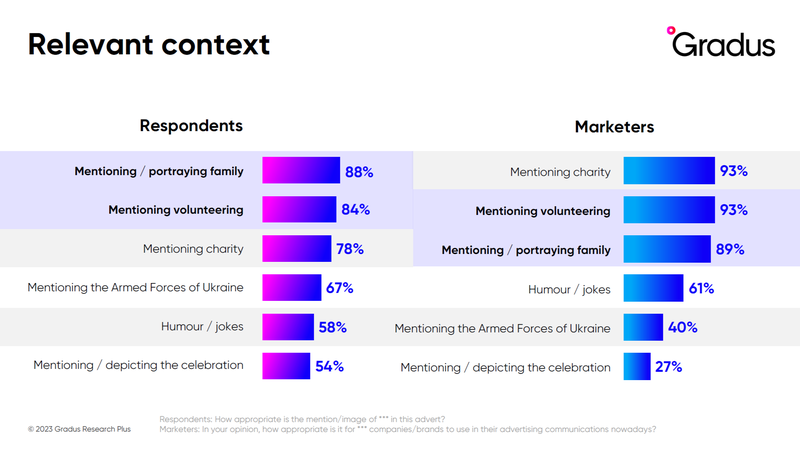
Family and volunteering – an appropriate context
Categories of Communication: What’s Acceptable?
The study examined six major contexts in advertising since the full-scale invasion. Based on the findings, these contexts were divided into three categories: appropriate, acceptable, and dangerous for communication. CMOs were also asked to determine whether each context was perceived as effective or traumatic.
Family and Volunteering: An Appropriate Context
Both consumers and marketing professionals agreed that referencing family and volunteering is appropriate during wartime. However, for CMOs, family-related content can be seen as risky. They worry that images of family could trigger negative emotions among people who have lost loved ones or been separated by the war. Despite this, in-depth interviews with marketers revealed that family remains a symbol of support and resilience, often providing a sense of stability and moral comfort.
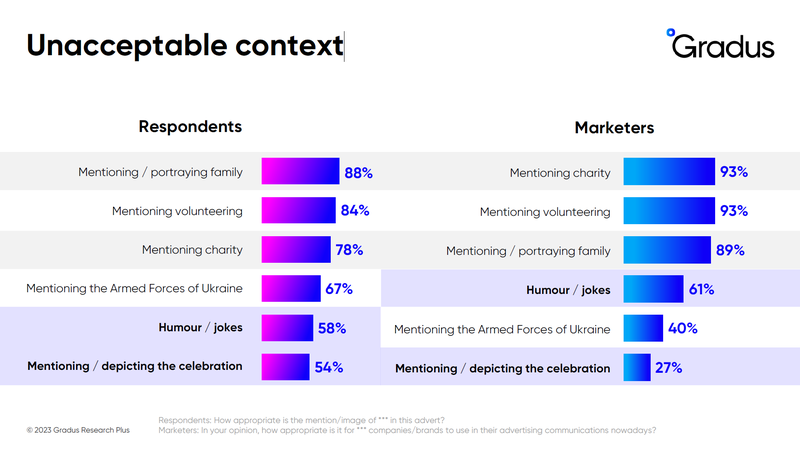
Parasitizing Military Symbols and Celebrations: Unacceptable
Using the symbols of the Armed Forces for marketing purposes—especially in a manipulative way, such as the phenomenon of “Bayraktarshchyna” (appropriating military symbols)—is seen as unacceptable by marketing professionals. Similarly, references to sensitive wartime events, such as Bucha and Irpin, are viewed as inappropriate due to their deeply traumatic nature. The military context can only be used in specific, well-grounded stories to avoid triggering negative emotions.
When it comes to humor and celebrations, CMOs and consumers tend to agree that these topics are tricky. While humor and celebration can be seen as a form of relief, they remain risky in wartime marketing.
Humor: Though humor is a significant tool for easing stress, it’s the most divisive category. 61% of CMOs and 58% of consumers find humor appropriate, but many others see it as a potential misstep. It’s a delicate balance, as humor is widely used on social media by the public, but it must be approached with caution in branding.
Celebrations: Wild or extravagant celebrations are generally off-limits. However, quieter, more personal celebrations within a family circle remain acceptable, signaling that emotional restraint is preferred in these times.
The Importance of Joy
One emotion that resonates strongly with consumers during the war is joy—though not necessarily in the form of loud celebrations or jokes. Joy can be expressed through acts of kindness, support for the Armed Forces, or small positive moments like charity efforts. This form of joy is seen as appropriate, uplifting, and essential in helping people move forward despite the ongoing challenges.
New Advertising Norms: A Guide for Brands
The insights from Gradus Research aim to guide brands in navigating this sensitive landscape. By evaluating the emotional impact of ads, brands can create more responsible and effective campaigns during the war. The study provides clear benchmarks for brands to avoid reputational crises by aligning their messaging with what society deems acceptable during wartime. This includes ensuring that the use of symbols such as the Armed Forces, humor, or celebrations is appropriate and respectful.
Survey Details
The study was conducted by Gradus Research for the Ukrainian Marketing Forum. The general survey included 5,000 respondents—men and women aged 18-60 living in cities with populations of over 50,000 (representing the target demographic). The SMO survey included 83 experts. Data collection took place between May 29 and June 12, 2023, with the SMO survey completed between June 15 and 20, 2023.
The full report is available for download via the form below.
CONTACT US
Do you have any questions for the Gradus Research team? Please fill out the form below, and we will get back to you shortly.