...

Changes in Media Consumption in Ukraine in 2024

Entertainment Content Surpasses News; Messaging Apps and Streaming Platforms Maintain Dominance

How Media Consumption in Ukraine Evolved in 2024 – Insights from Gradus Research

A recent Gradus Research survey highlights notable shifts in Ukrainians’ media consumption preferences, revealing significant changes in the popularity of content types and platforms. Conducted in October 2024, the study focused on both digital and traditional channels, the time spent consuming content, and evolving preferences for entertainment media, which has overtaken news as the most consumed category. The research was designed in collaboration with Kwendi, an independent media auditor, along with input from Suspilne and OMD Optimum Media Ukraine.

media content consumption stats 2024 survey results

Entertainment Content Overtakes News

Entertainment has surpassed news as the preferred media category for Ukrainians. Fictional films and TV series are now the top choice for 79% of respondents, followed by news and socio-political programs (68%) and music programs (63%). This shift reflects changes in public sentiment amid the ongoing war in Ukraine, with reduced optimism for a quick resolution, growing news fatigue, and a decline in real-time event tracking.


Messaging Apps Dominate News Consumption

Telegram and other messaging apps lead as primary news sources, used by 75% of respondents, followed by social networks like Facebook and Instagram (56%). Video platforms such as YouTube also play a key role, utilized by 51%, underscoring the popularity of multimedia news formats.


Video Platforms Reign in Entertainment Consumption

For entertainment, Ukrainians primarily rely on YouTube and similar video platforms, which account for 63% of content consumption in this category. These platforms are especially favored by younger audiences engaging with diverse digital video content. Social networks and messaging apps also play significant roles, with 58% and 53% of respondents, respectively, turning to these sources for entertainment.


Telegram Remains the Leading Messaging App

Despite government restrictions for certain groups, Telegram remains the most popular messaging platform, used by 90% of respondents. Viber (77%) and Facebook Messenger (51%) follow. While usage of these apps has slightly declined compared to 2023, WhatsApp has seen growth, increasing its user share from 21% to 30% over the past year.

telegram usage stats Media consumption stats messengers 2024


Facebook, Instagram, and TikTok Lead Among Social Networks

Facebook (72%) and Instagram (61%) continue to dominate social media use, with TikTok rounding out the top three. These platforms are central to news consumption, social interaction, and self-expression for Ukrainian users.


Streaming Services Becoming a Daily Habit

Streaming platforms like YouTube Music (45%) and Spotify (15%) are increasingly popular for music and video consumption, reflecting a shift from traditional media to digital formats.

“The growing preference for streaming platforms and social networks as primary entertainment sources demonstrates the influence of global trends, particularly among younger users. These habits are shaping Ukraine’s media landscape and will have lasting effects,” said Evgeniya Blyznyuk, sociologist and CEO of Gradus Research.


About the Survey

The study was conducted via a mobile app where respondents independently completed the questionnaire. It surveyed a representative sample of the urban population in cities with over 50,000 residents, aged 18–60, excluding territories under occupation or active hostilities. The fieldwork was conducted from October 25–27, 2024, with 1,050 respondents.

The full survey report is available for purchase at dn@gradus.app.


Report Highlights:

  • Media Content Preferences: Fictional films, news, and music programs
  • Channels for News Consumption: Messaging apps, social media, and video platforms
  • Entertainment Content Channels: Video platforms, social media, and messaging apps
  • Device Usage: Trends by age and gender
  • Social Network Engagement: Facebook, Instagram, and TikTok trends
  • Streaming Services Adoption: Usage by age and region
  • Media Usage Trends: Time spent on social media, video platforms, and online cinemas
  • Ad-Blocking Services: Adoption rates and demographics


Use of artificial intelligence in marketing: Gradus and dentsu survey report

89% of Ukrainian Marketers Use Artificial Intelligence, Over Half Are Unconcerned About Competition from AI – Survey Results

The global adoption of artificial intelligence (AI) continues to grow, with marketing and creative industries at the forefront of this trend. AI now generates not only images and text but also full-fledged commercials. How is AI perceived and utilized in Ukraine’s marketing sector, and what are its primary applications? In September 2024, Gradus Research, in collaboration with the dentsu Ukraine communication group, conducted a survey presented at the annual Future Lab event.

Key Findings from the Joint Survey by Gradus Research and dentsu Ukraine

Most Marketers Have Tried AI, But Few Have Mastered It

A significant 89% of surveyed marketing professionals reported using AI tools. Of these:

  • 32% identify as beginners,
  • 55% have intermediate experience (using AI for basic tasks),
  • 12% are advanced or expert users.

However, it’s notable that 44% of respondents have never undergone formal AI training, highlighting a gap in expertise.


AI in Marketing: A Growing Trend in Ukraine

The use of AI tools in marketing has surged in the past year:

  • 62% of respondents have adopted AI within the last 12 months, underscoring its status as a relatively new tool.
  • 92% use AI in their professional tasks, and 84% consider it highly beneficial.

“This sharp rise in interest is evident across the communications industry. Advertisers are increasingly seeking AI tools to automate processes and optimize costs. While many requests are exploratory, reflecting a lack of understanding of specific capabilities, I believe with greater education in this area, businesses will craft more targeted and specialized briefs,” said Oksana Stekhina, Chief Business Development Officer at dentsu Ukraine and Global Network Director at iProspect Global.


Top Applications of AI in Marketing

The primary areas where marketers use AI include:

  • Copywriting: 41%
  • Design: 33%
  • Information Search: 31%
  • Inspiration and Creative Ideas: 23%

Men are notably twice as likely as women to utilize AI for tasks such as data analysis and calculations.

“Many marketing professionals currently view AI as an assistant or junior-level specialist that helps save time. In fact, 83% of surveyed marketers cited time optimization as a key benefit of AI, which excels at quickly collecting, analyzing, and editing information,” commented Evgeniya Blyznyuk, sociologist and CEO & Founder of Gradus Research.


Challenges in AI Adoption

Despite widespread enthusiasm, barriers remain:

  • Lack of Knowledge: 50%
  • Difficulty with Integration: 37%
  • Privacy Concerns: 23%

Marketers Are Not Overly Concerned About AI Replacing Jobs

  • 56% of respondents do not believe AI will reduce the number of marketing roles.
  • However, a disparity exists: among advanced AI users, 55% anticipate AI might replace marketers, compared to just 33% of less experienced users.

Survey Details and Full Report Availability

The survey was conducted via a self-administered questionnaire on the Gradus mobile application. The target audience included men and women working in marketing. Key details:

  • Sample Size: 170 respondents
  • Fieldwork Period: August 16 – September 2, 2024

The complete report is available for purchase and includes comprehensive data on:

  • Perceptions of AI and its efficiency in marketing
  • Potential for AI to replace human labor
  • Levels of AI expertise and training
  • Use cases and applications in marketing
  • Benefits and barriers to AI adoption
  • Recommendations for AI tools

To purchase the full report, please complete the form below or contact us directly at info@gradus.app.


Could Reskilling Women and Older Workers Be the Key to Ukraine’s Future Success?

Ukraine faces a critical shortage of human resources, which has been further exacerbated by the ongoing war and the resulting migration crisis. One potential solution to this challenge is the reskilling of various demographic groups, including women and older workers. On September 25, at the IX Conductors of Changes Forum, Gradus Research and Deloitte Ukraine presented the results of a survey on Ukrainians’ willingness to switch careers, the barriers and motivations behind this shift, and the potential for women to retrain for traditionally male-dominated fields. The survey also examined whether Ukrainians are open to working past retirement age and under what conditions.


Ukraine’s Human Capital Crisis: Will Reskilling Help?

Despite the ongoing wartime challenges, Ukraine’s employment levels remain relatively high—79% of respondents are currently employed full- or part-time, with 58% working more than 30 hours a week.

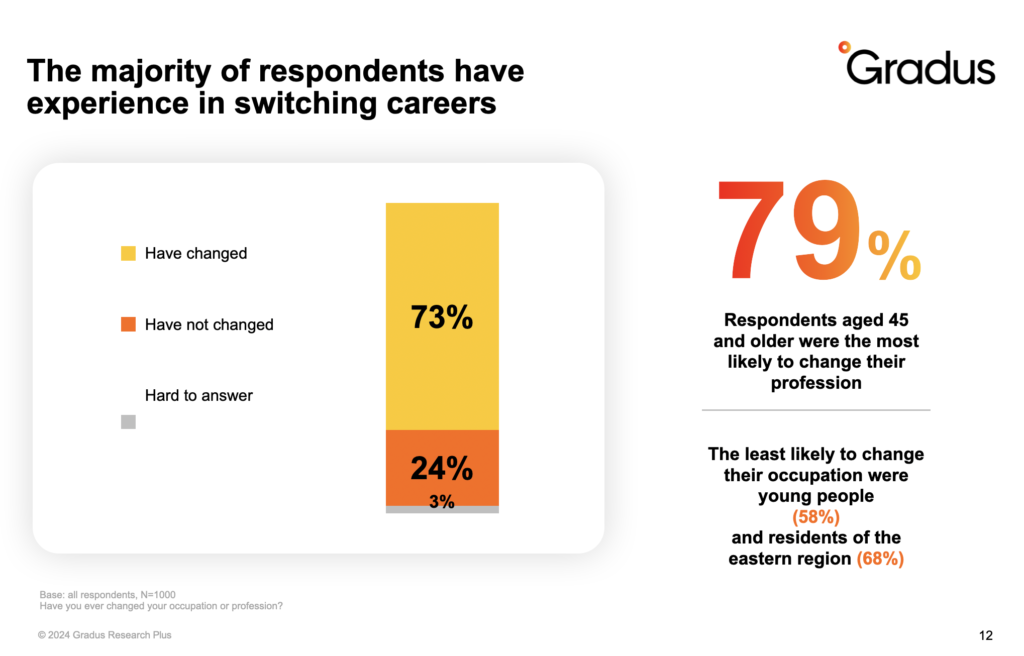
Over three-quarters of Ukrainians (73%) have changed professions at some point in their careers. Notably, 79% of those aged 45 and older have switched jobs, whereas younger people (58%) and residents of Eastern Ukraine (68%) have changed careers the least.

Human research survey reskilling Ukrainians

Training and Upskilling: A Growing Trend

One-third of respondents (31%) pursue additional training or professional development at least once a year. Women and younger workers tend to engage in further education more frequently than other groups.

Women and Older Workers: Ready for Change?

  • 45% of women are open to retraining for a new profession, including roles traditionally seen as male-dominated. Younger people, and those from Western and Northern Ukraine, are particularly inclined to pursue these opportunities.
  • 73% of respondents are open to working beyond retirement age, with many expressing a desire to remain in their current profession.

Openness to Reskilling: The Key to Economic Recovery

“Ukraine has demonstrated remarkable resilience under high levels of turbulence, and this is a strength. Ukrainians have adapted to wartime life, are actively engaged in the workforce, and are eager to retrain. However, while most people are open to new career opportunities and lifelong learning, 88% of respondents said they would be motivated to learn new skills if it led to higher earnings,” commented Evgeniya Blyznyuk, sociologist and CEO of Gradus Research.

“Ukraine has vast potential to engage underrepresented groups—such as women, older workers, and younger people—in the workforce. Many of them are open to new opportunities, ready to learn, and willing to change careers. However, challenges remain, including a lack of experience with career shifts and a limited number of workers who have pursued additional training (31% among older workers). Moreover, 41% of older respondents and 43% of women are not considering retraining for male-dominated fields,” said Olena Boichenko, Partner at Deloitte Ukraine.

Who Should Be Retrained for Male-Dominated Fields?

  • 50% of respondents believe women should be the primary focus for retraining into traditionally male professions, followed by veterans (44%), people with disabilities (43%), and older workers (42%).

Stress and Burnout: An Ongoing Challenge

The survey also revealed that the stress and burnout levels among Ukrainian women are increasing. 45% of women reported higher stress levels compared to the previous year, while 38% felt more burnt out.


Full Survey Report

The survey provides insights into the employment landscape in Ukraine, including:

  • Employment and unemployment reasons
  • Career changes and the frequency of those changes
  • Training and professional development habits
  • Openness to new professions and lifelong learning
  • The potential for retraining in male-dominated industries
  • The willingness to work beyond retirement age

To purchase the full report, please contact dn@gradus.app.

Online Shopping Trends and Digital Behavior of Ukrainians (2021-2023)

The war has significantly impacted the consumer behavior of Ukrainians, and the changes are especially noticeable when comparing data from before the war and after it began. Initially, the full-scale invasion altered daily life, but now we can identify more stable patterns in how people interact with the Internet. This ongoing shift is being studied to understand the current dynamics of Ukrainian online behavior.

In 2021, Gradus Research conducted a major study called Digi-nation, analyzing how Ukrainians used the Internet and identifying key audience segments. In September 2023, the research was repeated with about 1,900 respondents to track these behaviors over time.

Current State of Internet Use in Ukraine

The survey results show that 93% of Ukrainians use the Internet at home, 52% at work, and 42% while traveling. This widespread connectivity underscores how integral the Internet has become in daily life. The war has actually intensified this trend, with more people using the Internet for critical security information. Even older demographics, previously less digitally engaged, have become confident users of online platforms.

On average, 72% of respondents spend more than 4 hours a day online. While younger people tend to spend more time online, this figure is still notably high across all age groups. The COVID-19 pandemic played a major role in shaping this behavior, as it served as a preparatory stage for the war, encouraging remote work and online networking.

Devices Used for Internet Access

Smartphones dominate as the primary device for accessing the Internet, with 95% of respondents using them. In contrast, desktop computers are used by only 23%, and this group is mostly composed of people aged 45-54.

The Role of the Internet in Daily Life

For 91% of respondents, the Internet is now a social norm, as almost everyone they know uses it. 77% believe that without the Internet, they would lose contact with many of their friends and acquaintances. For 64%, working without the Internet is impossible.

Despite its ubiquity, trust in online information is low, with only 23% of people trusting what they find on the Internet. This distrust is more prevalent among people aged 35-60, although 68% of respondents pay close attention to the credibility of sources.

Key Segments of the Ukrainian Digital Audience

In 2021, Ukrainian Internet users were divided into six main segments, each with distinct behaviors. The war has led to some shifts in these groups:

  • Moderate users have slightly decreased, while the uninvolved group has grown a bit.
  • The pragmatists—a group of professionals—has seen the most significant decline, partly due to migration out of Ukraine.
  • The groups with the greatest growth are the Gossipers and Entertainment Seekers.

Among these segments, Advanced users and Gossipers are the most active, while Pragmatists and Entertainment Seekers are more moderate. Moderates and Uninvolved users represent the lower end of internet activity.

Online Shopping Trends

When it comes to online shopping, 87% of Ukrainians agree that buying goods and services online is easy, and this convenience is a key driver for online purchases.

  • 26% prefer to shop online, while 29% still prefer offline shopping. The rest of the population uses both methods interchangeably.

The impact of the COVID-19 pandemic in accelerating online shopping is well-known, but the war has further fueled this shift. According to Evgeniya Blyznyuk, sociologist and director of Gradus Research, online shopping has become a stable and essential part of daily life for 25% of Ukraine’s economically active population.

The Full Report

The full research report provides an in-depth look at the changing landscape of Ukraine’s digital habits, covering areas such as:

  • Socio-demographic profiles of digital users
  • Places and devices used to access the Internet
  • Time spent online and the importance of the Internet
  • Trust in online information
  • Challenges in using the Internet
  • Types of online activities (e.g., shopping, social media, work, entertainment)
  • Frequency of using messengers and social networks
  • Frequency of searching for medical, educational, and political information
  • Online shopping behaviors, including financial activities

This comprehensive study reveals how Ukrainians are adapting to new digital realities in the context of war, and how these shifts will likely shape future consumer behavior.

The full report is available on a commercial basis. For more details, contact dn@gradus.app.

The survey was conducted by Gradus Research using a self-administered mobile questionnaire. It reflects the population structure of cities with populations over 50,000, aged 18-60, covering gender, age, and regional distribution. The data collection took place from September 5-7, 2023, with a sample size of 1,896 respondents.