


The question of what brands can and should communicate, and where they should draw the line, remains crucial—especially in the context of a rapidly changing situation like war. What was once seen as a positive message may quickly turn into a traumatic experience for consumers. In Ukraine, over the course of the war, many brands have faced reputational risks due to their missteps with sensitive contexts or the inappropriate use of symbols in their messaging.
To address this, Gradus Research conducted a study for the Ukrainian Marketing Forum to explore what ordinary Ukrainians consider “red lines” in brand communications, and how their perceptions compare with those of marketing professionals. The findings help to establish new norms for what’s considered acceptable and unacceptable in advertising during the war.
The Study
The research comprised three key components:
- A review of 150 branded ads aired in Ukraine since the start of the full-scale invasion, evaluated by over 5,000 respondents using Gradus Research’s Gradus AdSpot methodology.
- A quantitative survey among Chief Marketing Officers (CMOs) who assessed whether certain categories of ads were appropriate or unacceptable during the war.
- In-depth interviews with CMOs to delve into the nuances of the context, including which types of celebrations or references are appropriate.
The New Normal: Living with War
“War is now our new normal,” says Evgeniya Blyznyuk, sociologist and founder of Gradus Research. The reality of a prolonged conflict has pushed expectations for its end further into the future. Most Ukrainians now expect active hostilities to continue until the end of 2024. This shift in perception is reshaping how both consumers and brands approach communication. Brands must continue marketing, but they must do so with great sensitivity to avoid making missteps in an environment that is continually evolving.
Family and volunteering – an appropriate context
Categories of Communication: What’s Acceptable?
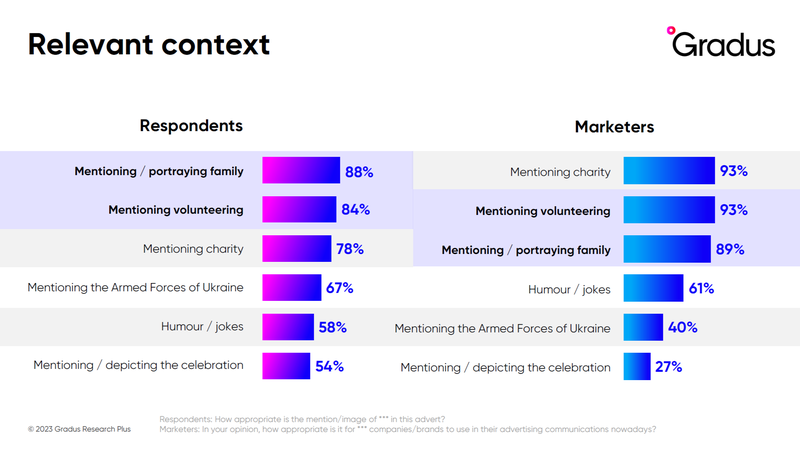
The study examined six major contexts in advertising since the full-scale invasion. Based on the findings, these contexts were divided into three categories: appropriate, acceptable, and dangerous for communication. CMOs were also asked to determine whether each context was perceived as effective or traumatic.
- Family and Volunteering: An Appropriate Context
Both consumers and marketing professionals agreed that referencing family and volunteering is appropriate during wartime. However, for CMOs, family-related content can be seen as risky. They worry that images of family could trigger negative emotions among people who have lost loved ones or been separated by the war. Despite this, in-depth interviews with marketers revealed that family remains a symbol of support and resilience, often providing a sense of stability and moral comfort.
- Parasitizing Military Symbols and Celebrations: Unacceptable
Using the symbols of the Armed Forces for marketing purposes—especially in a manipulative way, such as the phenomenon of “Bayraktarshchyna” (appropriating military symbols)—is seen as unacceptable by marketing professionals. Similarly, references to sensitive wartime events, such as Bucha and Irpin, are viewed as inappropriate due to their deeply traumatic nature. The military context can only be used in specific, well-grounded stories to avoid triggering negative emotions.
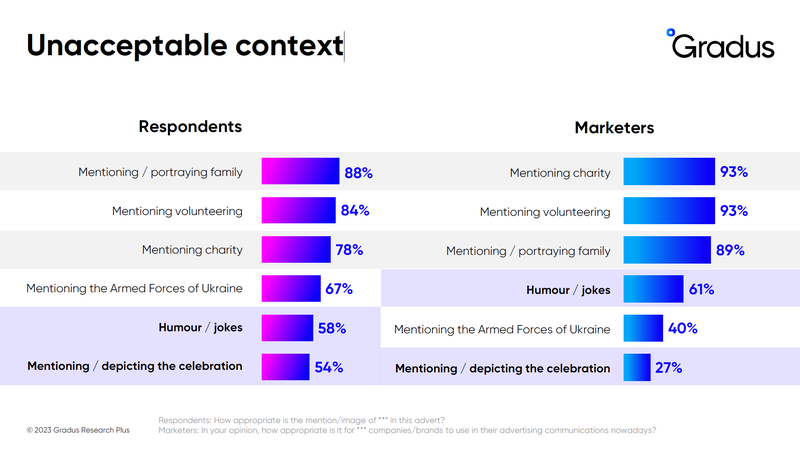
When it comes to humor and celebrations, CMOs and consumers tend to agree that these topics are tricky. While humor and celebration can be seen as a form of relief, they remain risky in wartime marketing.
- Humor: Though humor is a significant tool for easing stress, it’s the most divisive category. 61% of CMOs and 58% of consumers find humor appropriate, but many others see it as a potential misstep. It’s a delicate balance, as humor is widely used on social media by the public, but it must be approached with caution in branding.
- Celebrations: Wild or extravagant celebrations are generally off-limits. However, quieter, more personal celebrations within a family circle remain acceptable, signaling that emotional restraint is preferred in these times.
The Importance of Joy
One emotion that resonates strongly with consumers during the war is joy—though not necessarily in the form of loud celebrations or jokes. Joy can be expressed through acts of kindness, support for the Armed Forces, or small positive moments like charity efforts. This form of joy is seen as appropriate, uplifting, and essential in helping people move forward despite the ongoing challenges.
New Advertising Norms: A Guide for Brands
The insights from Gradus Research aim to guide brands in navigating this sensitive landscape. By evaluating the emotional impact of ads, brands can create more responsible and effective campaigns during the war. The study provides clear benchmarks for brands to avoid reputational crises by aligning their messaging with what society deems acceptable during wartime. This includes ensuring that the use of symbols such as the Armed Forces, humor, or celebrations is appropriate and respectful.
Survey Details
The study was conducted by Gradus Research for the Ukrainian Marketing Forum. The general survey included 5,000 respondents—men and women aged 18-60 living in cities with populations of over 50,000 (representing the target demographic). The SMO survey included 83 experts. Data collection took place between May 29 and June 12, 2023, with the SMO survey completed between June 15 and 20, 2023.
The full report is available for download via the form below.


